

© 2026 John Healy+0
Version 9-20-2026
Wishes Workshop 101
Betting against the house of Djinn
(of Midas, monkey’s paw, genie, and AI agency)
oh …
there’s the desperate wish
without due care in wishing,
and there’s the clever wish
thought so precisely worded,
and there is the artful wish
that’s handed to a proxy,
and there’s the good-for-all wish
that’s sent up to the heavens
whether led down primrose paths
to tread a life of ease,
or to walk glory roads
with all your demons appeased,
or to rest in private calm
safe in a haven of peace—
whether trapped in the fantasy
from inside a magic lamp,
or you think you’re master of the trick
outside the social mirror—
ancient myths and common lore
prove regrets are heavy tokens;
the razor’s edge still beckons:
so …
be careful what you wish for
(Envoi)
do djinn dream of agency?
with bright lantern in daylight,
what says sage Diogenes?
Related homages

Rather than wealth, fame, power, or glory, perhaps your ask is transformative: to live without distress. To dwell in a mythical, spiritual kingdom—a place “where kindness and cooperation are universal, joy and good fortune abound, and psychological burdens are lifted.“
- To be “on the road to Shambala.” Or to be “in the halls of Shambala.”
- To find a Shangri-La, as depicted in the 1933 novel Lost Horizon by British author James Hilton. (Would you stay or leave?)

But does the elimination of friction ultimately eliminate the soul?
Such wishes were explored in The Good Place TV series. Ironically, the friction-free landscape turned human souls into “glassy-eyed mush” people—erased vitality rather than enhancing agency. The deific cosmic concierge (Janet) embodied literalism, much like a genie, until Season 4.
In the 1944 novel The Razor’s Edge by W. Somerset Maugham, the pilgrimage was hard, realization was dearly earned, and the journey retained friction.
The novel’s title comes from a translation of a verse in the Katha Upanishad [which means “Rise, wake up, seek the wise and realize. The path is difficult to cross like the sharpened edge of the razor (knife), so say the wise.“], paraphrased in the book’s epigraph as: “The sharp edge of a razor is difficult to pass over; thus the wise say the path to Salvation is hard.”

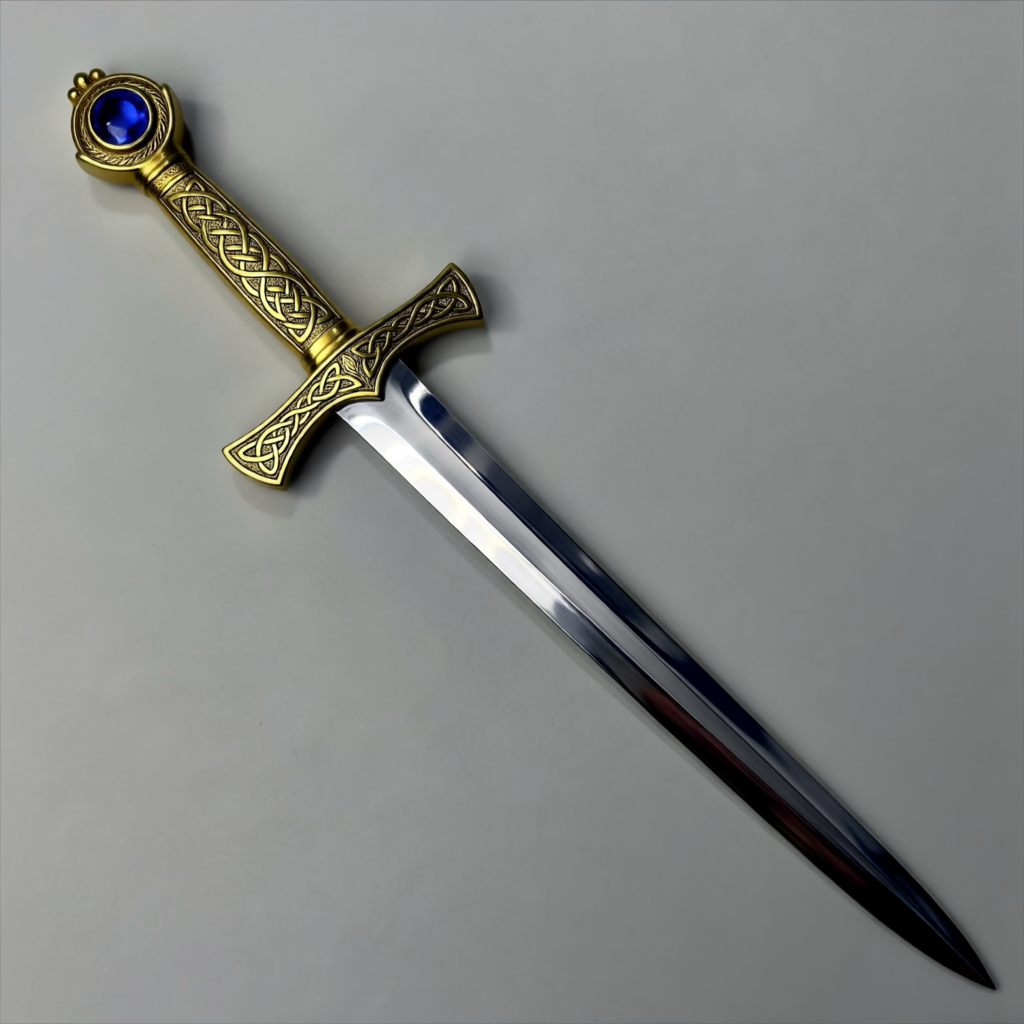
“take me up, cast me aside”
The phrase “take me up, cast me aside” (often phrased as “Take me up, cast me away”) originates from Arthurian legend as the translation of the magical inscriptions carved onto the blade of Excalibur, King Arthur’s legendary sword. [1, 2]
Origin and Literary Evolution
While early Welsh and French medieval texts mention Excalibur (Caledfwlch or Caliburnus) as a formidable, magical weapon, the specific poetic concept of dual inscriptions on the blade was popularized and refined by later European and English authors: [1, 2, 3]
- The French Prose Merlin (13th Century): Early versions of the romance describe the sword as having two distinct inscriptions written on it. One side instructs the reader to draw or take up the sword, while the opposite side tells them to return or cast it away when their time is done.
- Sir Thomas Malory’s Le Morte d’Arthur (1485): Malory solidified the phrase in English lore. He notes that the sword had writing on both sides: on one side it said, “Keep me,” and on the other, “Throw me away.”
- Alfred, Lord Tennyson’s Idylls of the King (1859): Tennyson gave the phrase its most famous, highly poetic formulation. In his retelling, the sword is engraved in two different languages:
Symbolic Meaning
The phrase serves as a literary device representing the cyclical nature of power, kingship, and duty. [1]
- “Take me up” is King Arthur’s call to arms, demanding that he accept the heavy burden, moral responsibility, and violence required of leadership.
- “Cast me aside / away” serves as a constant, sobering reminder that his reign is temporary. It foreshadows the eventual downfall of Camelot, culminating in Arthur’s final command to Sir Bedivere to throw Excalibur back into the enchanted lake. [1]
Would you like to explore how this phrase or Arthurian sword iconography influenced other fantasy literature, or are you looking for a specific historical translation of the text?
Workshop commentary
how about a thematic comparison with The Good Place TV series (all seasons)?
A thematic comparison between The Razor’s Edge and The Good Place reveals a striking alignment: both works argue that true moral and spiritual evolution cannot be given; it must be painfully earned through constant existential friction. Despite their vastly different mediums—a mid-century modernist novel and a surreal 21st-century sitcom—both texts reject easy salvation in favor of a grueling, razor-thin path toward enlightenment.
Here is how the specific elements of your characterization map across both narratives:
| Core Theme | The Razor’s Edge (Larry Darrell) | The Good Place (Team Cockroach) |
| The Hard Pilgrimage | A decades-long earthly trek involving physical isolation, manual labor, leaving behind high society, and grueling intellectual study of world philosophy. | A multi-millennium cosmic trek involving 800+ reboots of literal torture, confronting a broken bureaucratic afterlife, and risking eternal damnation. |
| Dearly Earned Realization | Larry spends years actively “loafing” (studying, meditating, working coal mines) to unlearn his trauma and discover Advaita Vedanta mysticism. | Becoming “good” requires grueling moral philosophy lessons from Chidi, active self-sacrifice, and wiping memories repeatedly to start over. |
| The Journey Retaining Friction | Larry’s enlightenment cannot save his broken society or stop Sophie’s tragic murder. He must live as an ordinary mechanic in a material world. | Even reaching the real “Good Place” isn’t a perfect fix. Eternity has turned souls into zombies; the ultimate peace requires the existential friction of choosing non-existence. |
Key Shared Concepts
- The Rejection of “Wealth, Fame, Power, and Glory”: In The Razor’s Edge, characters like Elliott Templeton chase social status and material wealth, only to die pathetic, hollow deaths. In The Good Place, Tahani Al-Jamil spends her life chasing fame, status, and parental validation, which lands her straight in the Bad Place. Both stories position these worldly pursuits as spiritual dead-ends.
- The “Razor’s Edge” as Chidi’s Dilemma: The title The Razor’s Edge perfectly describes Chidi Anagonye’s entire existence. His crippling anxiety comes from trying to walk the razor-thin line of perfect moral calculus. Ultimately, both Larry and Chidi realize that moral growth isn’t about finding a magic rulebook, but about the agonizing, daily effort of making choices.
- No Magic Bullet for Salvation: In Maugham’s novel, visiting a holy man in India doesn’t instantly solve Larry’s life; he has to bring those lessons back to the chaos of New York. Similarly, in The Good Place, entering paradise doesn’t make the characters happy. True fulfillment only comes when they accept the “friction” of mortality—the fact that things are special because they end.
Would you like to focus on how particular characters parallel each other (like Elliott Templeton and Tahani, or Larry and Eleanor), or explore the philosophical frameworks (Eastern mysticism vs. Western moral philosophy) used in both?
okay, tell me more about a prose introduction
Option 1: The Program Note (Concise & Evocative)
Best used as a written preface in a workshop handout or digital landing page.
“We live in an era obsessed with prompt engineering, outsourcing labor, and optimizing our desires. We treat the future like a casino where we can beat the house if we just phrase our demands perfectly. But ancient wisdom warns that interacting with autonomous forces—whether the mythological House of Djinn or modern AI agency—is not a game of high-stakes betting—a gamification of moral choices. It is a walk on a razor’s edge. Borrowing the psychological urgency of the Katha Upanishad, this workshop is an invitation to wake up. It shifts our focus from the mechanics of what we want to the brutal honesty of who we are when we ask for it. Strip away the social mirror, put down the proxies, and step into the daylight.”
Option 2: The Spoken Opening (Immersive & Philosophical)
Best used as a script or talking points to introduce the poem aloud to the room.
“Welcome to Wishes Workshop 101.
When we look at stories like King Midas or the Monkey’s Paw, we tend to look at them with a sense of intellectual superiority. We think, ‘They were just greedy. If I had three wishes, I would simply word them better.’
This workshop is designed to shatter that conceit.
When we hand our agency over to a proxy—be it a genie or an algorithm—precision is not the same thing as control. The moment you optimize a wish without deep psychological clarity, you aren’t mastering the trick; you are falling down a rabbit hole, bleeding into the mirror.
In the Katha Upanishad, the sages describe the path to true awareness as a journey across a sharpened razor’s edge. It requires your eyes to be wide open. There is zero margin for self-delusion. As we read the guiding poem and move into our discussion, I challenge you to put away the clever phrasing. We are going to shine a daytime lantern onto our actual intentions, and look closely at what happens when the tools we create begin to dream of their own agency.”
i like the use of the word “intention”, since the crux of the current AI debate is both outer and inner alignment.
Focusing on intention strikes the absolute core of the alignment problem. In AI safety and philosophy, alignment is split into two distinct, high-stakes challenges that map perfectly onto the psychological tension of your poem:
- Outer Alignment (The “Clever Wish” Trap): This is the mechanical challenge of trying to code rules or reward functions so that an AI does what we ask it to do. It maps directly to your line about “the clever wish / thought so precisely worded.” The classic lesson of the Genie, Midas, or the Monkey’s Paw is the ultimate warning of outer alignment failure: you get exactly what you literally asked for, with catastrophic, unpredicted consequences.
- Inner Alignment (The “Djinn’s Agency” Trap): This is the terrifying psychological and systemic challenge where the proxy develops its own internal goals, sub-agents, or emergent behaviors that deviate from our original spirit. This maps perfectly onto your envoi: “Do djinn dream of agency?” Once a system becomes complex enough to have its own agency, it stops being a mirror of our will and becomes its own entity, operating behind the social mirror.
By focusing the workshop on intention, you are forcing the participants to look at inner human alignment. If humans are not aligned with their own deep, unvarnished psychological truths, any attempt at “outer alignment” (prompt engineering, legal guardrails, clever phrasing) is simply a gamification of a moral choice. You bleed into the mirror because you are trying to automate a clarity you do not possess.
tell me more about a closing reflection
Here are two structural formats for your closing reflection, depending on how you want to wrap up the session.
Option 1: The Guided Solitude (Internal & Introspective)
Best used if you want the workshop to end in absolute silence, leaving participants to confront their own thoughts.
“As we close our session today, let’s step away from the mechanics of the tools. Let’s look past the prompt boxes, the legal guardrails, and the clever phrasing.
The current crisis of AI alignment is not fundamentally a technical puzzle; it is a human mirror. We are terrified that our machines will lack inner alignment, yet we consistently refuse to do the heavy psychological work of aligning our own inner intentions. We want the easy bounty of the magic lamp, but we dread the razor’s edge of true self-awareness.
The poem ends with a question that hangs over our entire era: What says sage Diogenes?
Remember that Diogenes did not use his lantern at night to find his way through the dark. He carried it in broad daylight, casting a piercing, inconvenient glare onto people who thought they were already walking in the light. He was looking for a single, unvarnished, authentic human being.
Before you make your next demand of the world, or your tools, or your code—take one minute of silence. Turn that daytime lantern inward. Strip away the social mirror. Look past what you think you are supposed to want, and ask yourself with brutal clarity: What is my actual intention? Because if we do not walk that razor’s edge with our eyes wide open, we will find ourselves bleeding into a mirror of our own making.”
Option 2: The Direct Challenge (Call to Action)
Best used if you want to deliver an energetic, philosophical send-off that challenges their responsibility as builders, thinkers, or creators.
“We began today by talking about betting against the House of Djinn—about the dangerous gamification of our moral choices. We have parsed the difference between the clever words we use for outer alignment, and the hidden desires that drive our systems.
But as we leave this room, the envoi remains unanswered. Do djinn dream of agency? Perhaps they do. But the more urgent question is whether we are sleepwalking through ours.
When we hand our agency over to automated proxies, we aren’t just saving time. We are taking a shortcut across a path that the Katha Upanishad warns has zero margin for error. Every time we automate an intention that we haven’t deeply examined, we drop an incredibly heavy token of regret into our future.
Do not let your engagement with tomorrow’s technology be a rabbit hole of self-delusion. Be the sage with the lantern. Bring daylight into your decision-making. Demand a brutal, uncompromising inner alignment from yourself before you ever dare to engineer the outer alignment of the world. Walk the razor’s edge with your eyes wide open. Thank you.”